Special Correspondent, Dhaka
A single-ship owner, a Dubai manager with one vessel, and a vessel that has changed its name four times: the MV Star Line’s ownership raises as many questions as its cargo.
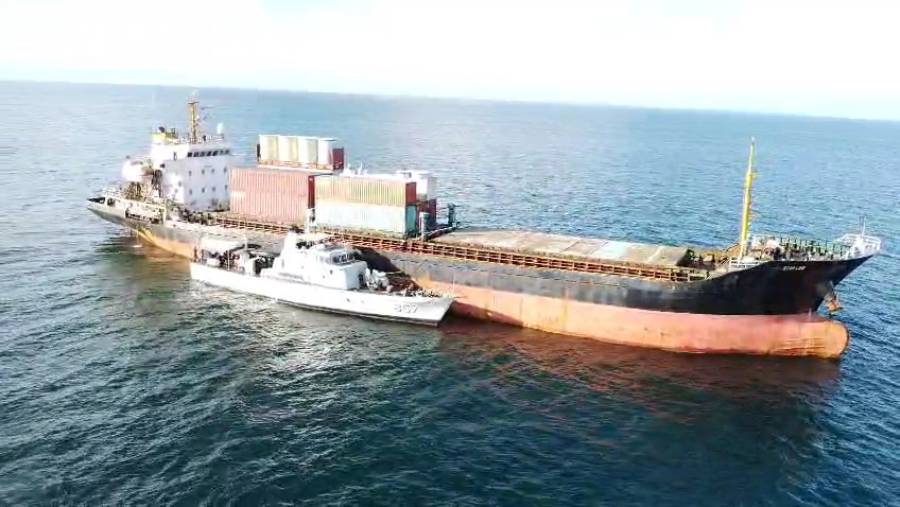
The MV Star Line was bound from China for Bangladesh’s Mongla port when Indonesia’s navy stopped it off Belawan. Its cargo included 405 tonnes of sodium perchlorate, a chemical used in rocket propellant and explosives, and the identities of the companies behind it are hard to pin down.
How it was caught
The vessel’s erratic movements first triggered a flag on the Seavision maritime surveillance system, according to details that have emerged. The navy patrol ship KRI Sigalu-857 then pursued it and detained it after it failed to answer radio calls.
Of the ship’s 36 containers, 15 held the sodium perchlorate, reportedly mixed with other materials. Investigators also found hundreds of thousands of unregistered, blank 4G LTE SIM cards stacked on 54 pallets. Officials say the chemical quantity could be enough for around 100 missiles. The ship has been taken to the Kodaeral I naval base, where the navy, the national narcotics agency, police, customs and immigration officials are examining it and its paperwork. The captain and crew are being interrogated, and investigators are checking whether the ship’s AIS tracking was deliberately switched off.
A vessel with many names
Records show the ship (IMO 8356962), built in 2009, has had at least four names. It began as Anjie Sun, became Friend Sunny in July 2022, Eversun in June 2024, and finally Star Line. It previously sailed under the Sierra Leone flag before moving to Comoros, whose registration is described as suspended.
Maritime analysts say frequent renaming and reflagging is a hallmark of “shadow fleet” vessels seeking to avoid scrutiny. Tracking archives show the ship, as Eversun, called at Russia’s Far Eastern port of Nakhodka in October 2025. It has no record of ever visiting Bangladesh.
Layers of ownership
The registered owner, Eversunny Ltd, has no other ships. Commercial management is listed under Dreamline Commodities DMCC, registered in Dubai’s Jewellery & Gemplex 3 free-zone complex. It too operates just one vessel, the 5,066-deadweight-tonne Star Line. Analysts note that single-ship companies are commonly used to preserve anonymity and to insulate other assets if a vessel is seized.
Neither company is formally sanctioned. But screening by MagicPort against more than 300 international watchlists rates Dreamline as “Elevated Risk,” citing its operating pattern and its ageing vessels, aged 16 to 25 years. It has only one recorded port state control inspection. Ships managed by Dreamline are reported to call regularly at Dandong and Binhai in China, near the North Korean border.
The ISM (safety) manager is Fujian Success Ocean Shipping, a mainland China-linked firm registered in Hong Kong. It runs four general cargo vessels totalling 44,908 deadweight tonnes, serving 61 ports including Zhoushan and Fuzhou. It, too, is rated “Elevated Risk.” Its other ships are the Teng Rui 1376, Changfa 168 and Heng Tong Zheng Yuan. Each has its own single-vessel owner, and the one identified, Wuhu New Run Da Marine Co Ltd of Hong Kong, is also rated Elevated Risk. Public data on the remaining two owners is very limited.
Analysts say the combination of UAE owners and managers, Hong Kong and Chinese technical management, and an African flag state appears designed to obscure who actually controls the ship and its cargo.
A route that doesn’t add up
Tracking data shows the ship called at Shidao and Lianyungang in China before anchoring at Singapore’s Eastern OPL anchorage from 7 to 27 October. It then left for Mongla. The passage from China to Mongla normally takes 10 to 15 days, but the ship spent nearly two months at sea after leaving Lianyungang, including 20 days anchored off Singapore. Investigators say this deepens suspicion about the shipment.
A quantity far beyond legitimate demand
Bangladesh’s legitimate need for sodium perchlorate, used in laboratories, HPLC analysis, pharmaceutical quality control and specialist electrochemistry, is estimated at between 50 kg and 2 tonnes a year. The seized cargo would cover roughly 200 years of that demand. Official trade statistics put all perchlorate imports in 2024-25 at about 27.2 tonnes, a figure covering every perchlorate salt, and prior shipments of sodium perchlorate into Bangladesh were tiny. The largest known, through Chattogram in 2022 and 2024, were only 99 kg each.
Silence on the buyer
No Bangladeshi importer has been identified, and the Bangladesh government has made no official comment. There is no indication the shipment was intended for a state agency or the military. Mongla Customs House says it received no advance information. Vessels must file an import general manifest at least 24 hours before arrival, and this one was intercepted before reaching Bangladeshi waters. Indonesian authorities have not disclosed customer details, citing the ongoing investigation.
Security analysts have warned that the blank SIM cards, which can be programmed with any network identity or cloned from legitimate subscribers, could serve armed groups operating in the Chittagong Hill Tracts and Rohingya camps. Authorities have not publicly linked the shipment to any group.
Until the Indonesian inquiry reveals who ordered the cargo and who controls the ship, the Star Line remains a vessel whose owners, managers and destination are all uncertain.