
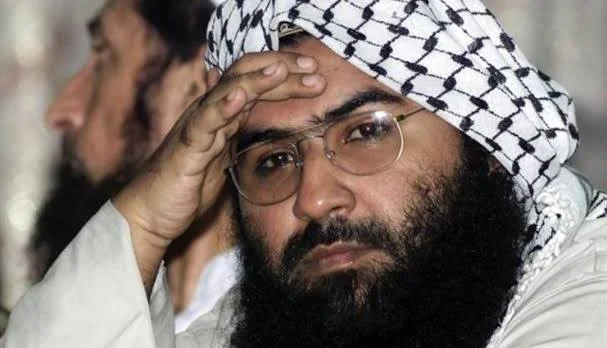
Desk Report
Pakistan has finally placed one of South Asia’s most notorious militant leaders near the top of its wanted list or, more precisely, raised the price already attached to him.
The Federal Investigation Agency’s updated 2026 “Red Book” identifies Jaish-e-Mohammed founder Masood Azhar as a fugitive and increases the reward for information leading to his arrest from PKR 2 million to PKR 7 million.
This is not Pakistan’s first formal action against Azhar, but it is the most conspicuous attempt in years to present him as a man being actively pursued.
The announcement immediately raises an uncomfortable question. If Pakistani authorities now consider Azhar dangerous enough to warrant a multimillion-rupee bounty, how did he remain beyond their reach for so long while his organization developed institutions, recruited cadres and operated from Pakistani territory?
The answer lies in the gap between Pakistan’s formal counterterrorism policy and its long-standing distinction between militants whose operations have historically served its regional objectives.
A fugitive who was rarely invisible
Masood Azhar’s story is inseparable from Pakistan’s use of armed Islamist groups as instruments of regional policy.
India released him in December 1999 after militants hijacked Indian Airlines Flight IC-814 and forced it to land in Taliban-controlled Kandahar. After returning to Pakistan, Azhar founded Jaish-e-Mohammed, or JeM, in 2000. The organization rapidly built a recruitment, fundraising and militant infrastructure, particularly around Bahawalpur in Punjab.
Pakistan formally banned JeM in 2002. Yet the organization survived through changing names, affiliated seminaries, welfare fronts and interconnected family and clerical networks. They maintained links with al-Qaeda and the Taliban. Its headquarters remained associated with Bahawalpur, where India struck a JeM-linked complex in May 2025.
Azhar was named by India in connection with several major attacks, including the 2001 assault on the Indian Parliament and the 2019 Pulwama suicide bombing, which killed more than 40 Indian paramilitary personnel. The United Nations designated him under the ISIL and al-Qaeda sanctions regime in May 2019, requiring member states to impose an asset freeze, travel ban and arms embargo.
Pakistani officials have periodically said that Azhar was missing, ill or possibly living in Afghanistan. But such claims have repeatedly collided with evidence of JeM activity inside Pakistan and the visibility of its infrastructure.
In May 2025, Indian missiles struck a JeM-linked compound in Bahawalpur. Azhar subsequently acknowledged that ten members of his family and four associates had been killed. The episode did not conclusively establish that he was physically present during the strike, but it reinforced how deeply his family and organization remained rooted in Pakistan.
That history makes the new bounty difficult to view as a routine law-enforcement decision.